
• September 01, 2026 7 min read

    When the saddle suddenly doesn’t fit - Look at your horse before you blame the saddle fitter

    Gastric ulcers, topline changes and nutrition may be more connected than many performance-horse professionals realize! How many of you have been in this situation? Your saddle fitter fits your horse carefully, the saddle is balanced and you are happy. Then, a few weeks later—or sometimes seemingly within days—you feel the saddle does not fit. Your horse looks narrower beside the withers. There is more clearance under the front of the saddle. The topline looks hollow. The saddle may feel less stable, the horse may object to being saddled or girthed, and suddenly you wonder what the saddle fitter did. But what if the saddle fit at the time and your horse changed within days? Is that even possible?

    For saddle fitters, equine chiropractors, massage therapists, trainers and other professionals who work hands-on with performance horses, an unexpected change around the withers can provide important information about much more than saddle fit. It can be an early reason to look at body condition, muscle function, appetite, workload, pain and digestive health—including the possibility of gastric ulcers.

    A horse’s back Is not a static structure

    Research involving sport horses confirms something experienced saddle fitters already know: the shape of the equine back changes. In one longitudinal study, researchers documented significant changes in thoracolumbar dimensions throughout the year. Bodyweight, work intensity, season, lameness and saddle fit all influenced those changes. Even more striking, another study demonstrated measurable changes in back width after only 30 minutes of ridden exercise. Horses working correctly in well-fitting saddles showed greater transient expansion of the back than horses working incorrectly or in poorly fitting saddles. [1,2]

    This matters because the saddle fitter is fitting a living, changing biological structure—not a wooden saddle stand. Changes in muscle development, body condition, posture and the way a horse carries its thorax can alter the saddle platform. The wither region is especially important because it is anatomically mobile and sits immediately adjacent to the front of the saddle. Recent three-dimensional research has also demonstrated that the shape of the equine back differs substantially between standing and locomotion. [3]

    That brings us to a frequently overlooked piece of the puzzle: the digestive system.

    Gastric ulcers and the topline: Where is the connection?

    Gastric ulcers are common in performance horses, and the clinical signs can be frustratingly nonspecific. Reduced appetite, poor body condition or weight loss, girthiness, behavioral changes and reduced performance have all been associated with Equine Gastric Ulcer Syndrome, or EGUS. Importantly, gastroscopy remains the appropriate method for confirming gastric disease because these signs can have many other causes. [4,5]

    For the saddle fitter or bodyworker, however, the diagnosis is not the point. Recognizing a change is. We have observed ulcer-prone performance horses appear noticeably more hollow alongside the withers during digestive flare-ups. Owners often describe this as the horse suddenly “losing its topline,” and what looks like disappearing padding beside the withers can make a previously appropriate saddle appear too wide. There is an important scientific distinction here. Current research does not demonstrate that gastric ulcers selectively metabolize fat beside the withers within several days. True local fat and muscle loss should therefore not automatically be blamed on an ulcer flare. But acupuncturists know that the wither areas are important meridian testing points for stomach sensitivity and -discomfort.

    What can change rapidly is the overall appearance and function of the saddle platform. Reduced feed intake, subtle changes in bodyweight or hydration, altered muscle tone, abdominal discomfort, guarded posture and changes in the way a painful horse lifts—or fails to lift—its back can all potentially influence what the eye and hand perceive around the withers. Meanwhile, gastric disease that persists can contribute to poor appetite and poor body condition over time. Research has also suggested that gastric pain may impair stride length and exercise performance. [4,5]

    So, when a horse that looked full through the withers last week suddenly appears hollow after hauling, competition, management stress or a period of poor appetite, the answer should not automatically be another pad or another saddle.

    For trainers, saddle fitters, chiropractors and massage therapists, this is valuable information

    Equestrian service professionals often see horses differently from veterinarians because they repeatedly put their hands on the same anatomical landmarks. A saddle fitter remembers how much tissue was present beside the withers at the previous fitting. A massage therapist notices that the thoracic musculature suddenly feels guarded. A chiropractor may notice a change in posture or willingness to lift the back. A trainer notices girthiness, resistance or a horse that no longer wants to move forward. Individually, none of those observations diagnoses a gastric ulcer. Together, however, they may tell the owner something has changed.

    This is why the best equine professionals increasingly work as a team. If the saddle fit has changed unexpectedly, especially in a competitive horse with recent travel, stress, reduced appetite, girthiness or declining performance, it may be appropriate to involve the veterinarian and review the feeding and management program before repeatedly changing equipment.

    Building topline requires more than protein

    When horse owners see a weak topline, the immediate reaction is often: “My horse needs more protein.” Sometimes that is true, but topline development is more complicated.

    Muscle protein synthesis requires adequate energy, training stimulus and an appropriate supply of indispensable amino acids. In horses, lysine and threonine have received particular attention as potentially limiting amino acids, meaning that inadequate availability can restrict the horse’s ability to synthesize body protein even when total crude protein intake appears adequate. Studies in horses have demonstrated relationships between amino-acid nutrition and lean tissue or muscle protein metabolism. [6,7]

    But there is another requirement that receives much less attention: The horse must eat, digest and utilize the ration consistently. A beautifully formulated diet accomplishes little if a performance horse becomes uncomfortable, reduces feed intake, loses condition or spends weeks training and competing with compromised digestive health.
    That is where a forage-first conditioning strategy becomes relevant.

    Amino acids in almond hulls

    Almond hulls are one of the principal ingredients in Cowboy Red Pellets, so we specifically examined published research on their amino-acid composition.

    A 2023 UC Davis study analyzed California and Nonpareil almond hulls and confirmed the presence of multiple indispensable amino acids. In California almond hulls, for example, researchers measured approximately 1.2 g/kg lysine, 1.1 g/kg threonine, 1.7 g/kg leucine, 1.3 g/kg valine and 0.9 g/kg isoleucine, along with phenylalanine, histidine and tryptophan. Essential amino acids represented roughly 28–31% of the total protein in the varieties studied. [8]. A separate 2023 analysis of almond hulls also identified indispensable amino acids including lysine, leucine, isoleucine, valine, arginine, histidine and methionine. [9]

    Although almond hulls are not a high-protein ingredient, they do contain essential amino acids along with soluble fiber and natural antioxidants.

    Where Cowboy Red fits into the topline equation

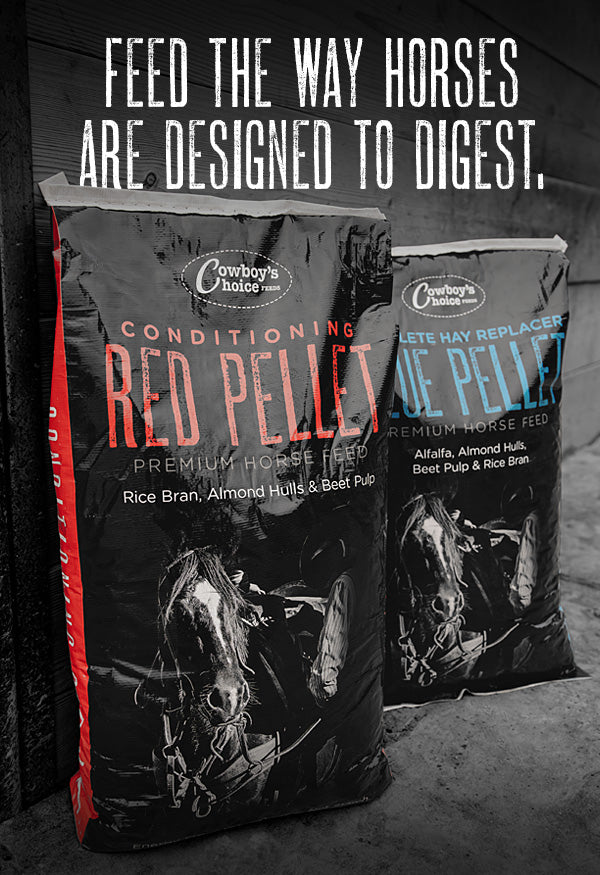
    Cowboy Red Pellets contain almond hulls and were developed as a grain-free conditioning ration to be fed alongside forage. The formula combines almond hulls, beet pulp and rice bran, providing calories primarily through highly digestible fiber and fat rather than relying on large grain meals. The current formulation also includes added vitamins and balanced minerals.

    That makes Cowboy Red particularly interesting for performance horses, hard keepers and horses that need better body condition without simply increasing conventional grain. Its role in building a better topline is therefore broader than “feed protein and grow muscle.”

    The goal is to provide the energy needed to maintain healthy condition, support the horse’s normal digestive system and create a nutritional environment in which training and an appropriately balanced total ration can produce muscle instead of simply adding calories.

    For horses with gastric-ulcer concerns, Cowboy Red pellets fit into a forage-based feeding strategy intended to reduce reliance on large grain meals while supplying conditioning calories from fiber and fat. High-concentrate feeding is among the management factors associated with gastric-ulcer risk, while adequate forage remains an important component of ulcer-prevention strategies. [4,5]

    Take-home message: When the topline changes, ask why

    A changing topline is not merely cosmetic. For the competitive dressage horse, jumper, eventer, cutting horse, barrel horse or racehorse, the musculature surrounding the spine contributes directly to the horse’s ability to carry a rider, stabilize the back and transfer power from the hindquarters. For the saddle fitter, that topline determines the surface on which the saddle must function. For the chiropractor and massage therapist, it is part of the muscular system they evaluate and treat. For the veterinarian and nutritionist, it can provide another piece of information about the health of the entire horse.

    So, if the area beside the withers suddenly looks different, especially in conjunction with girthiness, poor appetite, gastric-ulcer history, behavior changes, weight loss or decreased performance, do not look only at the saddle. Sometimes the changing saddle fit is only the clue.

    Feed the topline from the inside out

    Healthy muscle requires appropriate exercise, sufficient calories, quality protein, indispensable amino acids and a digestive system capable of making effective use of the ration. Cowboy Red Pellets provide a forage-based conditioning option built around almond hulls, beet pulp and rice bran for horses needing body condition and performance energy without heavy reliance on grain. Because a better topline does not begin with the saddle but the horse underneath it.

    Learn more about Cowboy Red Pellets and locate a store near you at CowboysChoiceFeeds.com.

    Scientific References
    1. Greve L, Dyson S. A longitudinal study of back dimension changes over 1 year in sports horses. Vet J.2015;203(1):65-73. doi:10.1016/j.tvjl.2014.10.031.
    2. Greve L, Murray R, Dyson S. Subjective analysis of exercise-induced changes in back dimensions of the horse: The influence of saddle-fit, rider skill and work quality. Vet J. 2015;206(1):39-46. doi:10.1016/j.tvjl.2015.06.009.
    3. Shape change in the saddle region of the equine back during trot and walk. 2024. PubMed PMID: 38916112.
    4. Vokes J, Lovett A, Sykes B. Equine Gastric Ulcer Syndrome: An update on current knowledge. Animals (Basel).2023;13(7):1261. doi:10.3390/ani13071261.
    5. Sykes BW, Hewetson M, Hepburn RJ, Luthersson N, Tamzali Y. European College of Equine Internal Medicine Consensus Statement—Equine Gastric Ulcer Syndrome in adult horses. J Vet Intern Med. 2015;29(5):1288-1299. doi:10.1111/jvim.13578.
    6. Mok CH, Urschel KL. Amino acid requirements in horses. Asian-Australas J Anim Sci. 2020;33(5):679-695. doi:10.5713/ajas.20.0050.
    7. Latham CM, Wagner AL, Urschel KL. Effects of dietary amino acid supplementation on measures of whole-body and muscle protein metabolism in aged horses. J Anim Physiol Anim Nutr (Berl). 2019;103(1):283-294. doi:10.1111/jpn.12992.
    8. Sitepu IR, Hitomi A, Wu W, Wu A, Jeoh T, Boundy-Mills K. Production of high protein yeast using enzymatically liquefied almond hulls. PLoS One. 2023;18(11):e0293085. doi:10.1371/journal.pone.0293085.
    9. Fanelli NS, Torres-Mendoza LJ, Abelilla JJ, Stein HH. Chemical composition of copra, palm kernel, and cashew co-products from South-East Asia and almond hulls from Australia. Anim Biosci. 2023;36(5):768-775. doi:10.5713/ab.22.0359.
    10. Hansen TL, Rankins EM, Bobel JM, McKinney M, Hackmann TJ, Warren LK. Postprandial blood glucose and insulin responses of horses to feeds differing in soluble fiber concentration. J Equine Vet Sci. 2020;88:102963. doi:10.1016/j.jevs.2020.102963.
    11. Clutter SH, Rodiek AV. Feeding value of diets containing almond hulls. J Equine Vet Sci. 1992;12(2):99-102. doi:10.1016/S0737-0806(06)81288-8.

    Leave a comment

    Comments will be approved before showing up.