
Your Cart is Empty


September 18, 2026 6 min read
Your horse may be done battling summer heat, but cooler weather brings a different hydration challenge. As temperatures drop, many horses drink less even though their hindgut still depends on a steady supply of water to keep intestinal contents moving normally. Understanding how salt, water and fiber work together can help support hydration and reduce the risk of impaction colic. This article covers details rarely found in common horse-care literature.
For example, did you know…
Sodium chloride, or ordinary salt, plays a central role in body-fluid regulation. Sodium and chloride are the major electrolytes of extracellular fluid, and sodium concentration strongly influences the osmolality, or concentration, of body fluids.
Across mammals, specialized areas of the brain monitor changes in sodium concentration and osmolality. Researchers have identified sodium-sensitive mechanisms, including the Na_x sodium channel, that participate in regulating thirst, salt appetite, hormone release and kidney function. In simple terms, a horse does not drink according to a daily gallon target. The body must generate the physiological signal to drink.
Study in a nutshell — horses respond to salt loss: Cornell researchers induced sodium and water loss in horses using the diuretic furosemide, and then observed their behavior. The horses responded by consuming more salt and more water than under control conditions, confirming that horses have functioning regulatory mechanisms for both salt appetite and thirst.
Adequate sodium therefore helps support the normal physiological signals involved in hydration rather than simply serving as another mineral in the ration.
A recent Colorado State University study compared block salt with loose salt in 16 mature horses over four 7-day periods and found that the form of salt made no significant difference in intake. What did matter was the individual horse. Intake ranged from approximately 2 to 135 grams per day, and more than half of the horses did not voluntarily consume enough salt to meet their estimated requirements. The researchers concluded that horses with inadequate voluntary intake should receive salt directly in their daily feed ration.
That finding is worth sitting with. Simply switching from a block to loose salt is not the solution, because some horses will under-consume either way. The reliable approach is to put salt in the feed.
For that reason, our simple hydration routine is to add one tablespoon of sodium chloride to the feed twice daily, while also offering loose salt free-choice so the horse can make additional individual adjustments. We prefer plain, unrefined white sea salt as the sodium-chloride source. Fresh water must always remain freely available, because added salt increases the horse’s water requirement.
Your horse has a water reservoir you may not know about. Most horse owners think hydration begins and ends with the water bucket. Keeping water clean, fresh and continuously available is essential, but hydration is more complex than simply how much a horse drinks. The horse has a sophisticated system for regulating sodium, thirst, water conservation and body-fluid balance. One of the largest and most overlooked water reservoirs is in the hindgut, particularly the cecum and large colon. This becomes especially important during hot weather and exercise, when horses lose both water and electrolytes through sweat, and during colder weather, when many horses begin to drink less. Understanding the relationship between salt, water and fiber gives us a more complete way to manage hydration throughout the year.
The hindgut is an internal water reservoir: The equine digestive tract contains a substantial amount of fluid, and most gastrointestinal water is in the large intestine. Veterinary researcher David Freeman describes an entero-systemic water cycle in which water continually moves between the circulation and the gastrointestinal tract. Water enters the digestive system during eating, digestion and fermentation, accumulates largely in the hindgut, and can later be absorbed back into the body. This makes the cecum and colon more than fermentation chambers. They also function as a meaningful internal reserve of water.
Fiber helps support that reservoir: The horse evolved to ferment fiber in the hindgut. The cecum and colon contain large microbial populations that break down fermentable fiber and convert it into volatile fatty acids, which the horse can use for energy. This fermentation system requires a well-hydrated environment. Different fibers interact with water in different ways, so it would be too simplistic to say that all soluble fiber automatically holds more water than all insoluble fiber. What the research does support is that fiber type and fiber intake can influence gastrointestinal water balance and the size of the hindgut water reservoir.
Study in a nutshell — fiber changed hydration during endurance exercise: Researchers studied Arabian horses during a 60-kilometer exercise test while feeding different fiber-based diets. The horses receiving the experimental fiber mixture showed physiological findings consistent with having access to a larger gastrointestinal water reserve. The important point is that feed is doing more than providing calories. The composition of the ration can influence how much water is carried within the digestive tract before and during exercise.
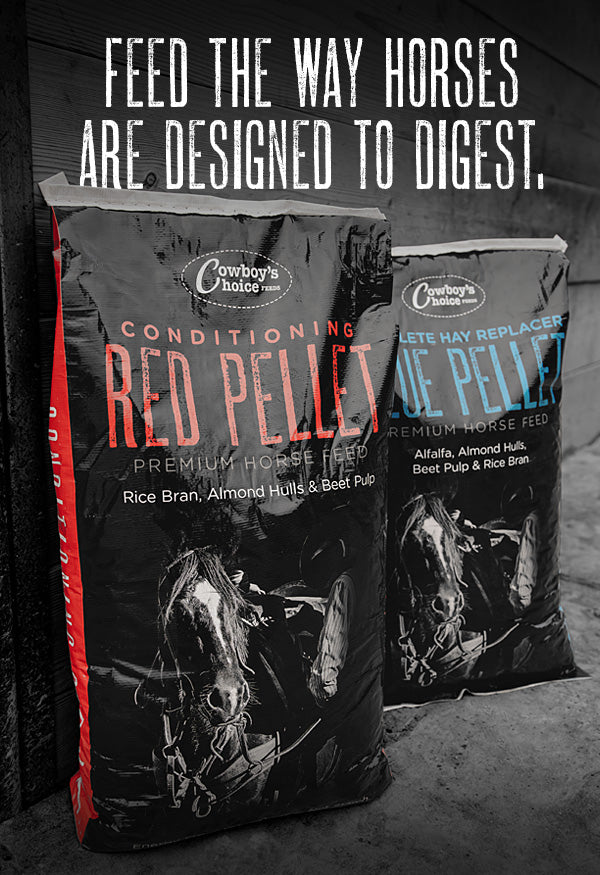
Other equine research using highly fermentable fiber sources such as beet pulp also confirms that changing dietary fiber composition affects digestive physiology and water balance. Both Cowboy Complete and Cowboy Red Pellets contain fiber-rich ingredients including almond hulls and beet pulp. Cowboy Complete is formulated as a complete hay replacer, while Cowboy Red is a conditioning feed designed to complement forage. The goal is not simply to feed more fiber, but to provide usable, digestible and fermentable fiber that works with the horse’s natural hindgut fermentation system.
Hot weather makes hydration an obvious concern because horses lose large amounts of water, sodium and chloride through sweat. However, colder weather can create a different problem, because horses may simply drink less. One study compared water consumption in ponies offered near-freezing water versus warmed water during cold weather. The ponies drank approximately 40% more when warm water was offered. This becomes important when a horse is eating dry hay while reducing water intake. Less drinking combined with drier intestinal contents can contribute to conditions that favor large-colon impaction, which is why sudden cold spells deserve just as much attention to hydration as summer heat.
The problem is not necessarily the cold itself, but the management changes that often accompany it: colder water, less drinking, more dry forage and sometimes less movement. During hot weather, the challenge is different. The horse may drink readily but continue to lose large amounts of water and electrolytes through sweating. In both situations, hydration depends on the balance between water intake, sodium supply and gastrointestinal fluid reserves.
A better way to think about hydration: Instead of asking only whether the horse is drinking enough, it is more useful to look at the whole system. Is the horse receiving enough sodium chloride to support normal fluid regulation and thirst mechanisms? Is clean, palatable water always available, and is the horse drinking it? Is the ration supporting a well-hydrated hindgut? These questions connect the water bucket with the feed bucket.
Fiber also belongs in the hydration discussion. A forage- and fiber-based ration supports the large intestine, its microbial population and the water-rich environment required for normal fermentation. Cowboy Complete and Cowboy Red Pellets can also be fed as a wet mash when additional dietary water is desirable. Horses evolved around continuous forage intake, microbial fermentation and a large, water-rich hindgut. Modern feeding programs often focus heavily on calories, supplements and performance nutrients while overlooking two of the simplest components of the ration: water and salt.
Good hydration depends on more than getting the horse to drink. It also depends on supporting the physiological signals that regulate thirst and maintaining a healthy gastrointestinal water reservoir.
Make hydration part of every feed bucket: For a healthy adult horse, add one tablespoon of sodium chloride to the feed twice daily, and also offer loose salt free-choice. Keep fresh water continuously available. During cold weather, warmer water may encourage greater intake, while during hot weather and exercise, increased sweat losses require even closer attention to hydration and electrolyte replacement. Support the hindgut with a fiber-based feeding program using Cowboy Complete or Cowboy Red Pellets.
Stay ahead of dehydration before your horse pays the price.
Freeman DE. Effect of Feed Intake on Water Consumption in Horses: Relevance to Maintenance Fluid Therapy. Front Vet Sci. 2021;8:626081. doi:10.3389/fvets.2021.626081.
Spooner HS, Nielsen BD, Schott HC II, O’Connor-Robison CI, Harris PA. Hydration status of horses performing endurance exercise: II. Evidence for a role of dietary fibre type, not oil supplementation. Comp Exerc Physiol. 2013;9:199-207. doi:10.3920/CEP13016.
Jensen RB, Austbø D, Bach Knudsen KE, Tauson AH. The effect of dietary carbohydrate composition on apparent total tract digestibility, feed mean retention time, nitrogen and water balance in horses. Animal. 2014;8(11):1788-1796. doi:10.1017/S175173111400175X.
Houpt KA, Northrup N, Wheatley T, Houpt TR. Thirst and salt appetite in horses treated with furosemide. J Appl Physiol. 1991;71(6):2380-2386. doi:10.1152/jappl.1991.71.6.2380.
Murphy B, Catalano DN. The effect of form on equine salt intake. J Equine Vet Sci. 2026;163:105923. doi:10.1016/j.jevs.2026.105923.
Kristula MA, McDonnell SM. Drinking water temperature affects consumption of water during cold weather in ponies. Appl Anim Behav Sci. 1994;41(3-4):155-160. doi:10.1016/0168-1591(94)90020-5.
Noda M, Sakuta H. Central regulation of body-fluid homeostasis. Trends Neurosci. 2013;36(11):661-673. doi:10.1016/j.tins.2013.08.004.
Noda M, Hiyama TY. Sodium sensing in the brain. Pflugers Arch. 2015;467(3):465-474. doi:10.1007/s00424-014-1662-4.
Comments will be approved before showing up.
Sign up to get the latest on sales, new releases and more …
Cowboy’s Choice Premium Horse Feed makes nutrition simpler with a low-starch, fat- and fiber-driven formula designed around the way horses naturally digest. Our forage-based feeding system supports efficient digestion and a balanced hindgut, helping horses get more from their feed while supporting gut health, muscle development, and steady, cool energy for performance—without unnecessary stress on the digestive system.
Give your horse the nutrition nature intended—find your Cowboy’s Choice dealer today.
