
Your Cart is Empty


February 06, 2026 2 min read
Why less grain often delivers more performance
When horse owners talk about their experience with our grain-free, fiber-based Cowboy Red Pellets, one result comes up again and again: ulcers fade away. Not because the horses suddenly became calmer—but because the stressor inside the digestive system changed.
How grain-based feeds contribute to ulcers
Most digestive problems don’t start in the mind. They start in the feed bucket.
Grain- and starch-heavy rations are still widely used to provide “energy.” The downside? Large grain meals stimulate excessive stomach acid production. Over time, repeated acid surges are a primary contributor to gastric ulcers.
When stomach ulcers become hindgut problems
Ulcers rarely exist in isolation. When starch isn’t fully digested in the small intestine—and much of it isn’t—it passes into the hindgut, where it ferments rapidly. This process lowers hindgut pH, disrupts beneficial microbes, and sets off a cascade of issues, including:
What looks like excess forage is often a stressed hindgut signaling trouble.
Why Cowboy Red Pellets were developed
Cowboy Red Pellets were created to address this exact problem. Instead of relying on grain and starch, they provide cool, sustained energy from fat and fiber.
Because they’re grain-free and fiber-based, they don’t trigger excessive stomach acid production—making a meaningful difference for ulcer-prone horses. But the real advantage shows up further down the digestive tract.
The almond hull advantage (and why it matters)
Nearly half of Cowboy Red Pellets are made from almond hulls—and that’s intentional.
Almond hulls are a highly digestible, soluble fiber. They’re easy for horses to process and act as a natural prebiotic, selectively supporting beneficial hindgut microbes while helping reduce inflammatory stress.
The result is a leaner, more athletic, better-conditioned horse.
What most owners notice in 4–8 weeks
(Feeding ~6–8 lbs per day alongside hay)
Not hotter. Not heavier. Just better fueled.
The takeaway
Sign up to get the latest on sales, new releases and more …
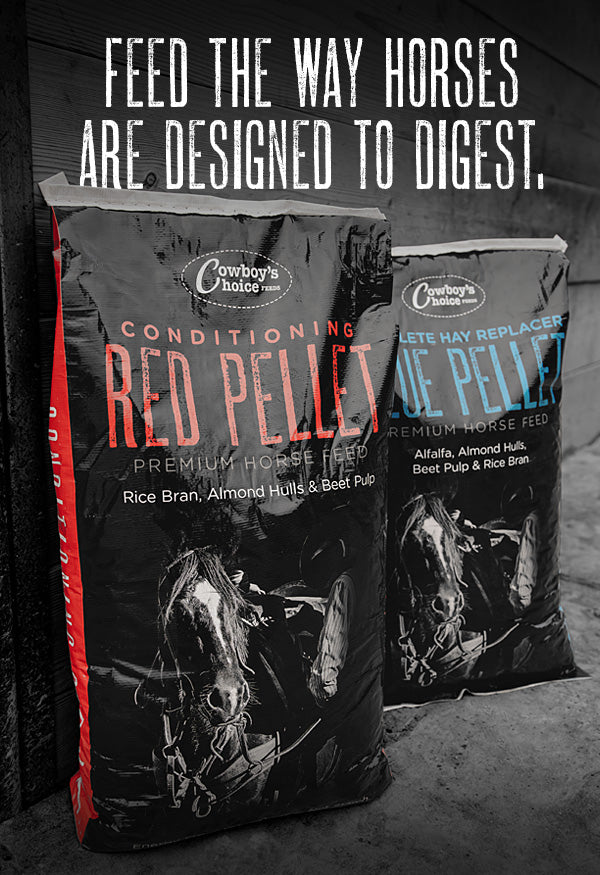
Feed the way horses are designed to digest.
Cowboy’s Choice Premium Horse Feed is a low-starch, fat- and fiber-driven approach that simplifies nutrition while promoting gut health, muscle development, and performance. Built on a forage-based feeding system, it supports digestive efficiency and whole-horse health with easy-to-digest fiber that lightens the load on the gut.
