Your Cart is Empty



 A horse that once held weight easily may suddenly appear thin, lose topline muscle, and struggle to recover from exercise or illness. At the same time, many aging horses become more sensitive to traditional concentrate “senior” feeds that can aggravate digestive problems or metabolic disease. Understanding why this happens, and how to feed senior horses differently, is the key to restoring healthy weight, conditioning, and vitality.
- Reduced ability to digest and absorb nutrients
- Reduced appetite
Loss of muscle mass and topline
Increased inflammation
- Higher risk of metabolic conditions such as insulin resistance or PPID (Cushing’s)
- Slower recovery after training or illness
Simply upping the amount of standard senior feed usually doesn’t fix the problem—and can make digestive issues worse.
The equine digestive system was designed to digest predominantly fiber. When senior horses are fed large amounts of harder to digest concentrates, the stomach and foregut can become overwhelmed.
The role of super fiber in healthy weight conditioning
When using conventional feeds, undigested material reaching the hindgut may disturb microbial balance and contribute to hindgut acidosis, digestive inflammation, and poor nutrient utilization. In contrast, modern feeding strategies increasingly focus on fiber-based conditioning diets. Commonly, the fiber used in conventional senior feeds is still not easily digestible. This is where almond hull-based feeds such as Cowboy Blue® and Cowboy Red® Pellets come in. Almond hulls are an easily digestible (“soluble”) fiber source which reduce the digestive stress significantly. This soluble fiber acts as a natural prebiotic, supporting beneficial microbial populations and improving digestive efficiency.
Almond hulls are called a “super fiber” because of their high number of natural antioxidants and vitamins, especially Vitamin E and K.
Cowboy’s Choice Feeds are easy to digest. Unlike coarse hay fiber, almond hull fiber is easier for the horse’s digestive system to break down and convert into usable energy. Their total digestible nutrient value (TDN) of almond hulls is approximately 62–64%, about 30-40 percent higher than typical hay. This means horses can obtain more usable nutrition with much less digestive stress.
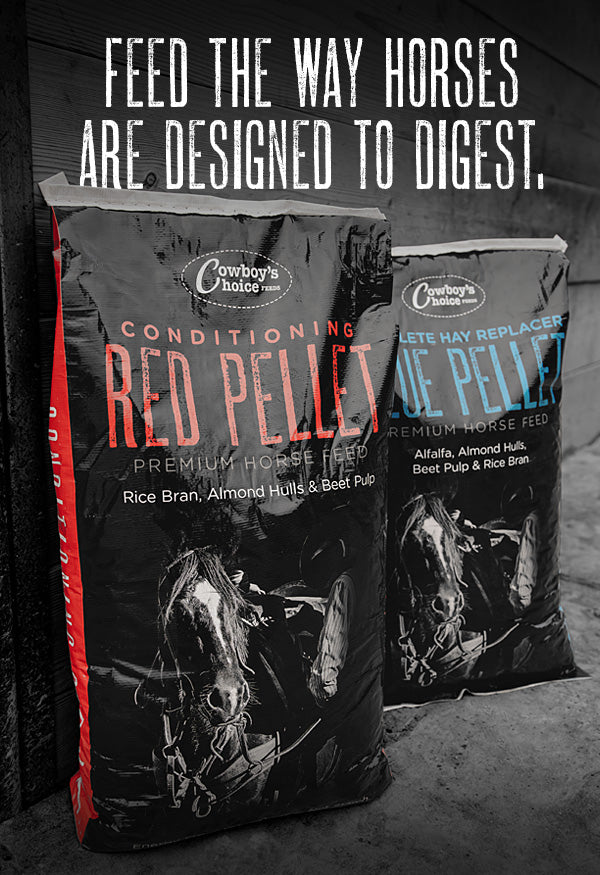
Cowboy Red® Pellets combine several ingredients that support safe weight gain and conditioning:
Together, these ingredients supply cool energy from fat and fiber rather than starch, making them suitable for performance horses, hard keepers, and aging horses alike.
For horses with conditions that require a low starch diet, The Cowboy Blue® Pellets are ideal, providing a revolutionary low starch content at 1-4%, and a total NSC content of 11%.
When senior horses transition to Cowboy’s Choice® feeds, horse owners commonly observe:
Feeding Guidelines
The pellets can be fed dry or soaked into a mash, which many senior horses prefer, especially if dental issues are present. Always introduce any new feed gradually over a period of 10–14 days.
The objective of senior horse nutrition isn’t simply to add more calories. Instead, it focuses on restoring digestive efficiency, easing metabolic strain, supplying safe and sustainable energy, and delivering protein the body can effectively use.
Fiber-based feeds made with highly digestible ingredients—such as almond hulls, beet pulp, and rice bran in Cowboy Red® Pellet, along with low-starch alfalfa and the hay-replacement support found in Cowboy Blue® Pellet—reflect a shift toward feeding practices that work with the horse’s natural physiology rather than against it.
A horse is essentially a digestive system on legs. When that system functions well, the benefits become visible in the horse itself: healthier body weight, stronger muscle development, improved recovery, and renewed vitality. Your senior horse deserves nothing less.
Learn more about Cowboy’s Choice Red Pellets or find a feed store near you.